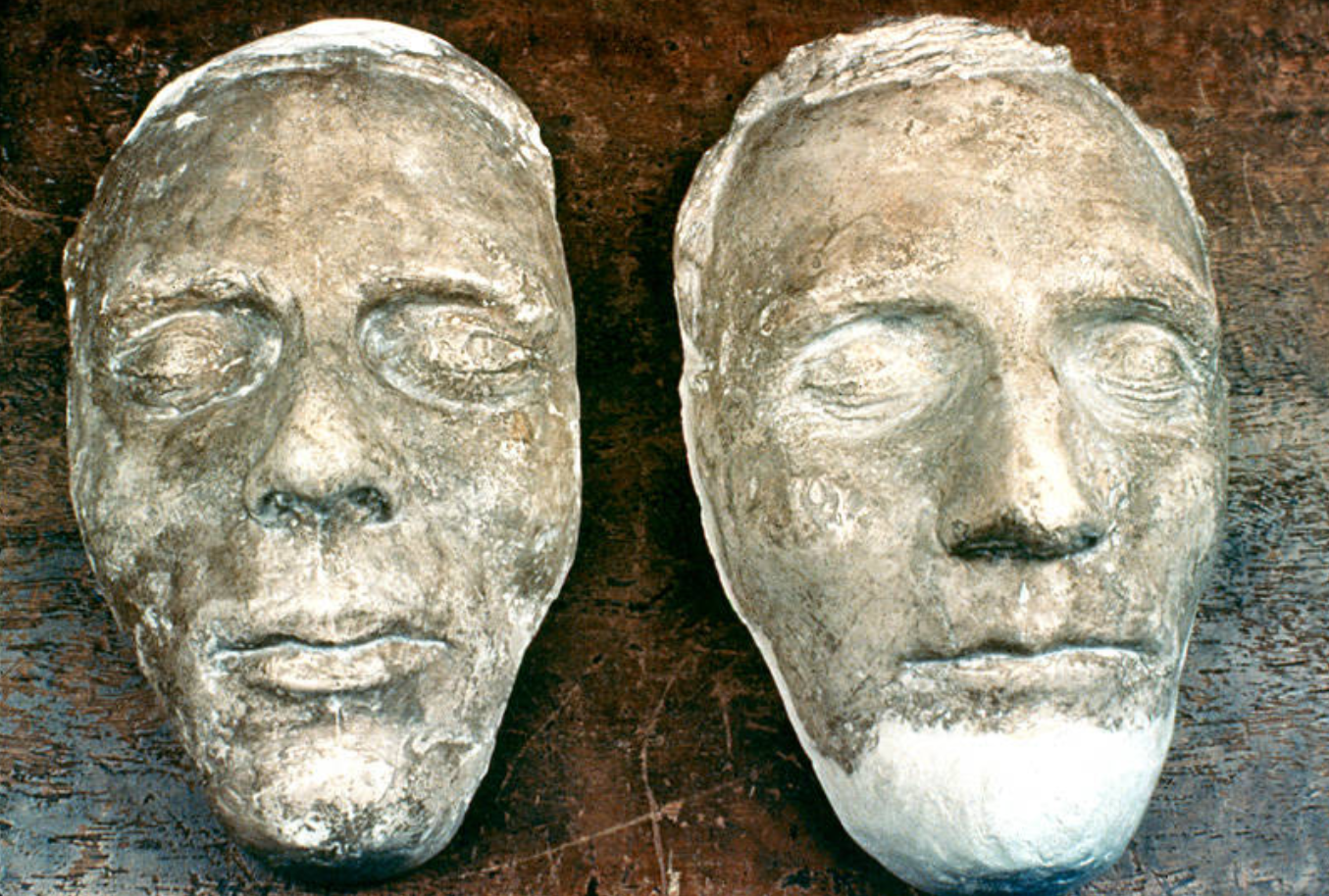
The historian Richard Bushman opens his biography of Joseph Smith by recounting a scene in his mother, Lucy Mack Smith’s life – as she reacts to the death of her sons, Joseph and Hyrum, in 1844. Lucy Mack Smith writes,
“I had for a long time braced every nerve, roused every energy of my soul, and called upon God to strengthen me; but when I entered the room, and saw my murdered sons extended both at once before my eyes, and heard the sobs and groans of my family, and the cries of “Father! Husband! Brothers!” from the lips of their wives, children, brother, and sisters, it was too much, I sank back, crying to the Lord, in the agony of my soul, “My God, my God, why has thou forsaken this family.”[1]
While reading this quote, I was instantly thrown back to my very first New Testament class – where we discussed the narrative contents of the Gospel of Mark. Hanging on the cross, Jesus “cries out with a loud voice, “Eloi, Eloi, lema sabachthani?” which means, “My God, my God, why have you forsaken me?”[2] But those persons who are familiar with Biblical criticism know that even this quote, as it appears in Mark, appears in a much earlier text: Psalms. In fact, the very first lines to Psalm 22 are “My God, my god, why have you forsaken me? Why are you so far from helping me, from the words of my groaning?”[3] So, when Lucy Mack Smith cries out to God on behalf of her family, what is she doing? Answer: it’s complicated.
When Lucy Mack Smith repeats Mark 16:18, she is drawing upon a long scriptural tradition – invoking the image of a dying Jesus on the cross while looking at the bodies of her dead sons. She is scripturalizing a moment of agony.
But what is scripturalizing? What does it mean to be scripturalized? Believe it or not, there are several academic perspectives on this question. For example, Vincent Wimbush defines scriptualization as a process that, “refers to the ideology and power dynamics and social and cultural practices built around texts.”[4] Additionally, Dr. Seth Perry describes that the process of scriptualization creates “a privileged distinction between this text and other texts.”[5]
So how does all of this relate to Lucy Mack Smith’s exclamation? Well, we can begin by breaking down the scriptural history that Lucy Mack Smith is drawing upon when she exclaims “My God, my God, why has thou forsaken this family.” Most immediately, we can draw upon Lucy Mack Smith’s reference to Mark’s crucifixion scene. The words themselves are iconic. Dr. Seth Perry has argued in his chapter The Many Bibles of Joseph Smith that early Mormons were adept at scripturalizing – often scripturalizing themselves in the process. When faced with her son’s death, Lucy is invoking a biblical climax – a moment of uncertainty and doubt. In this moment, she is enacting a common social and cultural practice built around the Bible. By invoking Jesus’ own death on the cross, Lucy is bringing a new meaning to the death of not only Joseph, but Hyrum as well. However, unlike the biblical narrative, the ending to this narrative is different.
Even Mark 15:34 is drawing upon an older, Jewish tradition. During the climax of the authors crucification scene – Jesus tilts his head to the sky and exclaims “Eloi, Eloi, lema sabachthani.” When Jesus utters this phrase, we can argue that the author of Mark is pulling upon their own scriptural tradition – although I don’t wish to speculate on the authors motivations. The author of Mark privileges Psalms by invoking its language – thus solidifying it within the author’s own cannon.
Within the Joseph Smith’s biography, Richard Bushman opens with this scene – not with Joseph Smith’s birth, but the reaction of his mother to his death. One point that the Bushman makes clear throughout the book is that the life of Joseph Smith cannot be essentialized to his own life. Much of what we know about his life comes from the writings of others – especially after his death.
Let’s end by asking a question: “Can A Person Be Scripturalized?” Yes. By invoking Mark at the time of her son’s death, Lucy Mack Smith scripturalized their physical body and death – pulling upon a common cultural tradition within 19th century America. The authoritative tradition of Mark pulls upon a longer authoritative tradition of Psalms and thus authorizes Lucy Mack Smith’s own use of Mark to scripturalized her sons. When Richard Bushman uses Lucy’s scene to open the biography of Joseph Smith, we are inclined to remember the subtitle of the work: rough stone rolling. Now of Joseph’s death, is that rough stone now smooth? Or is Joseph’s stone still eroding and becoming smooth?
What we cannot forget is that in this epic saga of scriptualization, authors are complexly authorizing their own interpretations. They make authoritative claims around (and surrounding) scriptures – whether those scriptures be part of “older” traditions (or actively made in the process). Retroactively, those scriptures become the basis of new interpretations and meaning construction. Richard Newton calls for us as scholars of scripture to remember, “The scripturalizing activities entailed are at times conspicuous and subtle, novel and mimetic, but refracting them helps to fathom the conceptually and categorically-ellusive phenomenon that accompanies much of what people do to themselves and others.”[6] Thus, unbinding the scriptural discipline is tedious, complex, and an ever-reflective process of analyzing the politics of social/cultural refraction.
[1] Richard Bushman, Joseph Smith: Rough Stone Rolling: A Cultural Biography of Mormonism’s Founder, 8.
[2] Mark 15:34, NRSV.
[3] Psalms 22:1, NRSV.
[4] Vincent L. Wimbush, “Every Person There Read the Bible … “: Scripturalization as Matrix of White Men’s Magic,” in White Men’s Magic: Scripturalization as Slavery, ed. Vincent L. Wimbush (Oxford University Press, 2012), https://doi.org/10.1093/acprof:oso/9780199873579.003.0004.
[5] Seth Perry, Bible Culture and Authority in the Early United States (Princeton University Press, 2018), https://doi.org/10.23943/9781400889402.
[6] Ritchard Newton, “Revisiting Scriptures: Unbinding a Critical Comparative Subfield,” Religion Compass 17, no. 12 (2023): e12480, https://doi.org/10.1111/rec3.12480.
